Slip Form Barrier vs. Precast Barrier: How the Choice Actually Gets Made
Neither barrier type is better. They solve different problems, and the job in front of you usually answers the question before anyone has to argue about it.
September 1, 2026 · 4 min read
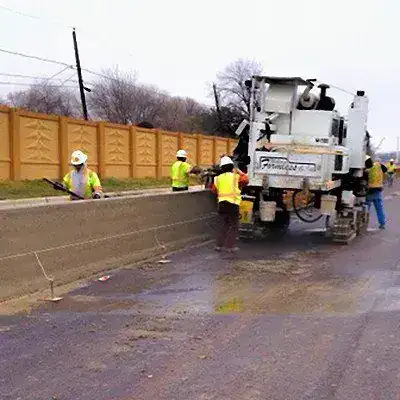
We pour both slip form and precast barrier, and the honest answer to "which one should we use" is that the project usually decides it for you. The choice isn't about which method looks better on a job-site photo. It's about how long the barrier needs to stay, how the roadway around it is going to be used while it's there, and what happens to the schedule if a section needs to move.
Slip form: continuous, permanent, and fast once it starts
Slip form barrier is placed with a paver that extrudes the concrete into shape continuously as it moves down the line, forming the wall in one pass without the seams that come from setting individual sections. Once that paver is moving, it keeps moving, and a long run of barrier wall goes up fast and stays consistent for its whole length. That continuity is the real advantage. There's no joint every few feet where water can work its way in over the years, no seam pattern to maintain, and the finished wall reads as one piece because it was placed as one piece.
That makes slip form the natural fit for permanent barrier wall, the kind that's going to sit on a highway median or shoulder for the life of the roadway. It's also the right call for long runs where efficiency matters, because a slip form crew covers ground a lot faster than a crew setting precast section by section. The tradeoff is that slip form wants a clear, prepared path to work down. It's not the tool you reach for when the barrier needs to go in and come back out on a tight schedule tied to shifting lane closures.
Precast: staged, adjustable, and built for a work zone that's going to move
Precast barrier sections are cast ahead of time, hauled to the site, and set in place with a crane or a forklift, one section connected to the next. That's slower per linear foot than slip form, and it does mean joints between sections. But it buys flexibility that a continuous pour can't. Precast sections can be picked up and reset when a traffic control plan changes, when a work zone needs to shift lanes for a different phase of construction, or when the barrier is only needed for a defined stretch of the project before it comes back out.
That's why precast is the standard choice for temporary barrier in an active work zone. A highway project that's going to run through several phases, with lane closures moving from one side of the road to the other as different sections get built, needs a barrier system that can move with it. Precast does that. Slip form, once it's placed, is placed. If a lane closure plan calls for barrier that goes up on a Monday and comes back out three weeks later when that phase is done, precast is the only version of this that makes sense.
How the work zone drives the decision
Every highway job runs on a traffic control plan, and that plan is really the thing choosing the barrier type before anybody formally decides. A project with one long-term closure and a straight run of roadway to protect for the duration of construction leans slip form, because the barrier goes in once and stays. A project with staged closures, where traffic is shifted from one half of the roadway to the other as work progresses, leans precast, because that barrier has to come out of one lane configuration and go into the next.
Duration matters too, separate from staging. A barrier that's protecting a crew for two weeks doesn't justify the setup a slip form paver needs to mobilize and run. A barrier that's going to stand for the life of a highway, on the other hand, is exactly what slip form was built for, and the smoother, jointless wall it produces is worth the mobilization on a job that size.
Where the two overlap
- Permanent median or shoulder barrier on a completed roadway: slip form, for continuity and speed on a long run
- Temporary barrier through a multi-phase work zone with shifting lane closures: precast, for the ability to reset sections as the plan changes
- A short-duration closure protecting a crew for days or a few weeks: precast, because mobilizing a slip form paver isn't worth it for that length of run
- A long-duration closure lasting most of a project's schedule: either can work, and the call often comes down to what the traffic control plan already has staged for that phase
We've poured barrier both ways for a long time, and neither method is the default answer. The traffic control plan, the phasing, and how long that section of road is going to look the way it looks right now, those are the questions that answer it. Get those answered early and the barrier choice is usually the easy part of the job.
Aaron Concrete Contractors, (512) 926-7326
Call (512) 926-7326More articles
What Clean Concrete Actually Means at a Recycling Scale
Clean concrete makes good base material. Dirty concrete makes a pile nobody can sell, so the scale house asks the same three questions every time.
Curb Poured by Machine and Curb Poured by Hand
A curb machine can run a straight line all day. It's the radii, the returns, and the tie-ins where a crew with a float earns its keep.