Curb Poured by Machine and Curb Poured by Hand
A curb machine can run a straight line all day. It's the radii, the returns, and the tie-ins where a crew with a float earns its keep.
September 1, 2026 · 4 min read
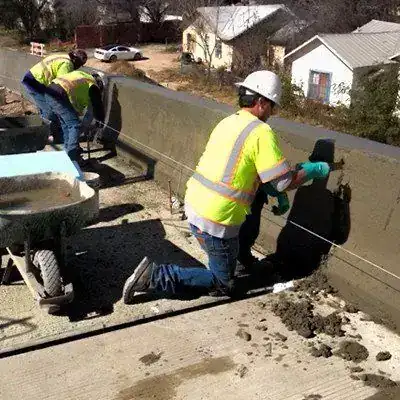
Curb work sounds simple until you're the one standing next to a driveway return trying to explain why the machine can't just do the whole thing. We pour curb both ways, by machine and by hand, and on most jobs we end up doing both on the same run, because each one is right for a different part of the job.
What the machine is good at
A curb machine extrudes concrete continuously through a mold as it moves forward, producing a consistent profile along a straight or gently curving run without a crew hand-finishing every foot of it. On a long stretch of roadway where the curb line runs parallel to the pavement for a few hundred feet at a stretch, that's the efficient way to do it. The profile stays consistent, the crew isn't hand-troweling the same shape over and over, and a long run gets covered a lot faster than it would with forms and hand finishing.
The machine wants a clear, prepared path and a run long enough to justify setting it up. It's not built for tight geometry, and it's not built for stopping and starting every few feet to work around an obstruction. Where the curb line is straight, the grade is set, and the run is long, the machine is the right tool and it's not close.
Where hand work takes over
Radii are the obvious one. Anywhere a curb line turns a corner, wraps a cul-de-sac, or curves into an intersection, the geometry changes too fast for a machine to run cleanly, and that stretch gets formed and finished by hand instead. Driveway returns are the same problem in miniature. Every driveway crossing a curb line means the curb has to drop, transition, and tie back in on the other side, and that transition gets built with forms and a crew, not a continuous extrusion.
Tie-ins are the other place hand work is non-negotiable. Where new curb meets an existing structure, a catch basin, an old section of curb from a previous phase, a driveway apron that's already in place, somebody has to form that joint and finish it so it reads as one continuous line instead of a visible seam. That's finished by hand with a float, the same way it's always been done, because there's no version of a curb machine that solves a tie-in.
Joints, cure, and why finish quality still shows up years later
Even the sections a machine runs need control joints cut or tooled in at set intervals, so the curb has a planned place to crack instead of cracking wherever it wants to once it shrinks and cures. A hand-formed section carries that same requirement, tooled in while the concrete is still workable rather than saw cut afterward, and it takes a crew that knows the timing to get a joint that looks intentional instead of ragged. Finish quality on hand work is also where experience shows the most. A float finish that's worked too long gets slick and loses its texture. One that's worked too little leaves it rough and prone to raveling at the edge. Both of those show up within a year or two, long after the crew has moved to the next job, which is exactly why hand-finished sections aren't handed to whoever happens to be free that morning.
Many sizes and shapes, in practice
Curb isn't one profile. Barrier curb, mountable curb, curb and gutter combined into one pour, ribbon curb without a gutter pan, different heights and different back slopes depending on what the roadway design calls for. Some of those profiles run through the machine with the right mold swapped in. Others, especially where a profile changes partway through a run or where a custom shape is needed to tie into an existing condition, get formed and poured by hand because that's the only way to get an exact match. Having both methods available means the crew isn't stuck forcing a machine profile onto a spot that needs something else, or hand-pouring an entire mile of straight curb because one tricky section needed hand work somewhere in the middle.
How a job actually runs
- Machine handles the long straight and gently curving runs where the grade is set and the path is clear
- Hand crews take the radii at intersections and cul-de-sacs where the geometry turns too tight for the machine
- Driveway returns get formed and finished by hand, one at a time, as the machine run passes each one
- Tie-ins to existing curb, catch basins, or prior phases are always hand work, because matching an existing structure isn't something a mold does
On a real project this isn't an either-or decision made once at the start. It's a running call made section by section as the crew moves down the line, machine where the machine belongs, hand work where the geometry demands it. That's what curb built to hold up for decades actually takes, whether the run is a residential street, a commercial site, or a stretch of highway shoulder.
Aaron Concrete Contractors, (512) 926-7326
Call (512) 926-7326More articles
What Clean Concrete Actually Means at a Recycling Scale
Clean concrete makes good base material. Dirty concrete makes a pile nobody can sell, so the scale house asks the same three questions every time.
Slip Form Barrier vs. Precast Barrier: How the Choice Actually Gets Made
Neither barrier type is better. They solve different problems, and the job in front of you usually answers the question before anyone has to argue about it.