Setting Box Culvert Under a Live Roadway
The culvert itself is the easy part. The sequencing around it, keeping traffic moving while a hole opens under the roadway, is where the real work is.
September 1, 2026 · 4 min read
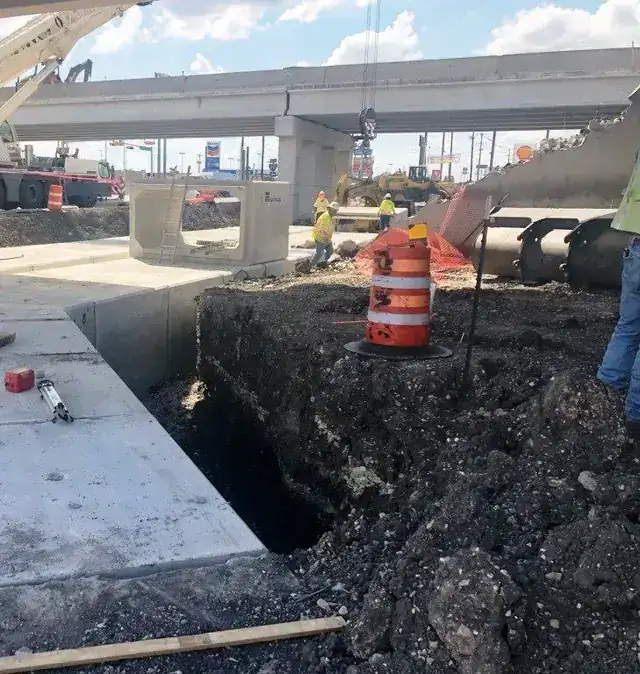
Setting box culvert under a highway that's still carrying traffic is one of those jobs where the pipe itself, or in this case the precast box sections, is the least complicated part of the day. Sequencing everything around keeping the roadway open, or getting it back open fast, is where the schedule actually lives or dies.
Traffic control comes first, not last
Nothing about a box culvert install starts until the traffic control plan is in place. That usually means shifting traffic onto a partial closure, running one lane in each direction, or in some cases detouring traffic entirely for a defined window while the crossing is open. Every hour that plan is active costs something, both in the barrier and signage that has to be maintained and in the pressure to get the roadway back to its normal configuration. On a live roadway, the traffic control isn't a formality wrapped around the real work. It's the frame the whole schedule has to fit inside.
The trench and the bedding
Once the roadway is protected, the trench gets excavated to the depth and width the culvert design calls for, cutting through the existing pavement section and the subgrade beneath it. The bottom of that trench has to be prepared before anything gets set in it. A prepared bedding layer, brought to grade and compacted evenly, is what the culvert sections actually rest on, and getting that grade right matters more than almost anything else on the job. A box culvert set on an uneven or under-compacted bed will settle unevenly after backfill, and an unevenly settled culvert under a live roadway is a problem that shows up later as a dip or a crack in the pavement above it, long after the crew has moved on.
The crane pick
Box culvert sections are precast, heavy, and set with a crane, one section at a time, lowered into the trench and aligned end to end with the section before it. Getting the pick right means the crane operator and the ground crew are working off the same line and grade the whole time, because a section set even slightly out of alignment throws off every section that follows it down the run. Joints between sections get sealed as each one is set, so the finished culvert reads as a continuous box for the water passing through it, not a series of separate pieces loosely lined up.
Backfill and compaction
Once the culvert run is set and joined, backfill goes in around it in lifts, compacted in stages rather than dumped and packed all at once. That matters structurally, because the backfill material around a box culvert is doing real work, supporting the load that's eventually going to sit on top of it again once the roadway is restored. Backfill that's compacted in proper lifts holds that load evenly. Backfill that's dumped in all at once and compacted from the top down leaves loose zones lower in the trench that settle later, which is exactly the kind of problem nobody wants to find months after the roadway reopens.
Pavement restoration and getting the road back
The last stage is rebuilding the roadway section over the completed backfill, matching the subgrade, base, and pavement structure that was there before the trench opened, so the finished surface ties in smoothly with the existing road on either side. This is the step drivers actually see, because it's the point where the lane closure comes out and the roadway looks normal again. Everything before it, the trench, the bedding, the crane pick, the backfill, is invisible from a car window, but it's what determines whether that restored pavement holds its grade for the next twenty years or starts showing a dip within a season.
What traffic control actually costs the schedule
- Every phase of the culvert install has to fit inside whatever lane configuration the traffic control plan allows for that stage
- A partial closure that only opens up one work area at a time stretches the schedule compared to a full closure or detour, even though it keeps more traffic moving
- Weather delays hit harder on a live roadway job, because a rained-out trench day doesn't just push the schedule, it extends how long the traffic control has to stay in place
- Coordinating the crane pick around traffic control timing, rather than around the crew's own pace, is often the single biggest scheduling constraint on the job
A box culvert set under a live roadway is a sequencing problem wearing a construction job's clothes. Get the trench, the bedding, and the crane pick right and the culvert itself behaves for decades. Get the traffic control sequencing wrong and none of that quality matters, because the schedule, and the road above it, both suffer for it.
Aaron Concrete Contractors, (512) 926-7326
Call (512) 926-7326More articles
What Clean Concrete Actually Means at a Recycling Scale
Clean concrete makes good base material. Dirty concrete makes a pile nobody can sell, so the scale house asks the same three questions every time.
Slip Form Barrier vs. Precast Barrier: How the Choice Actually Gets Made
Neither barrier type is better. They solve different problems, and the job in front of you usually answers the question before anyone has to argue about it.